You need to read and accept the Confidentiality Undertaking in order to activate this tool. Please click here
SQuADS (Subjective Quantitative Assessment Decision Support Tool)
An interactive tool to select best-fit structural system
What is the context?
The primary objective of performance-based earthquake engineering design is the ability to deliver a building system that satisfies expectations of the client in terms of building performance while considering other factors such as cost and downtime in the event of an earthquake. At the initial stages of building design, a dialogue between the engineer and the client is preferable to strike a balance between the client’s expectations and the possibilities of providing appropriate engineering solutions. Essentially, there could be a number of criteria (wish-list) from a client’s perspective, and possibilities and constraints from engineer’s view point in providing design solutions. Such a scenario can be viewed as ‘multiple criteria decision making process’ that may be dealt with a subjective and a quantitative approach, particularly at a conceptual level.
To facilitate dialogues between clients and engineers at preliminary stages, a platform is developed in the form of an ‘interactive tool’ where multiple criteria that are relevant in decision making are considered to compare and choose the ‘best-fit’ structural system.
SQuADS: What is it?
It is an interactive tool that adopts a weighted scoring method, a technique used in multiple criteria decision making process which enables setting a measure of objectivity into a subjective process. This method is simple and flexible, yet a powerful method to compare different options of structural systems against a list of criteria or requirements representing performance or benefits expected. A numeric value is assigned as ‘weight’ to the criteria according to the importance as desired by the client.
Each main criteria can be linked to further sub-criteria related to engineering aspects and be given sub-weight factors.
A set of possible structural systems that are considered for comparison can be given a score against each sub-criterion considered, independently of its importance. The scoring indicators may be either descriptive that can be mapped to numerical values or direct numerical values.
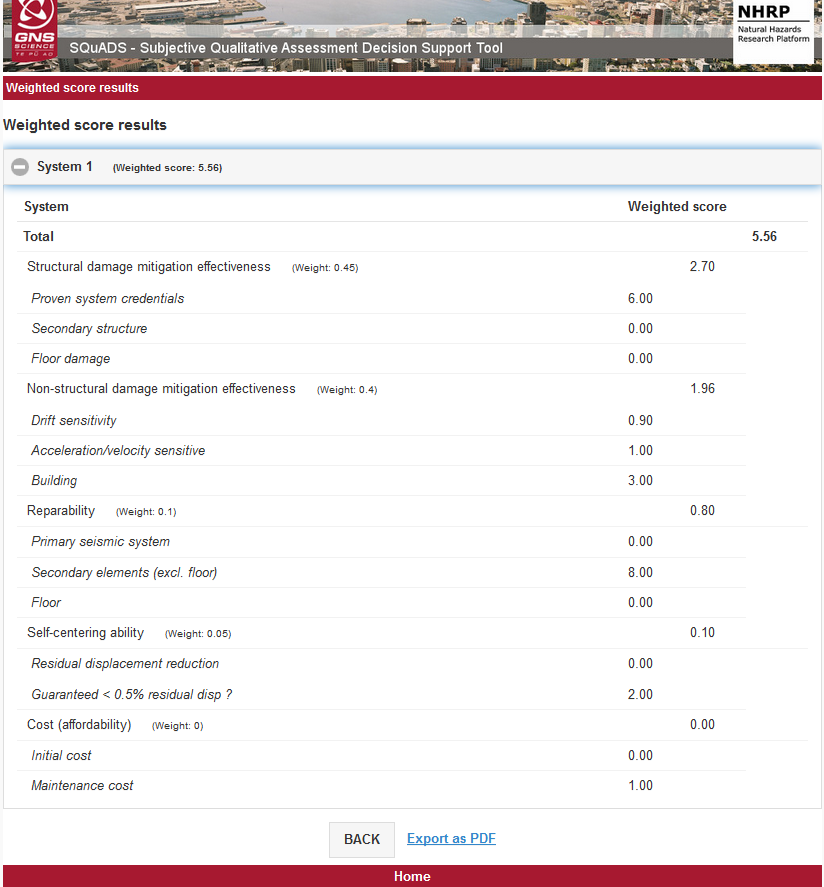
The assigned scores and weights are used to calculate the total weighted score for each structural system options considered for comparison purpose.
How the tool should be used
The steps to be followed are explained below.
Assigning weights
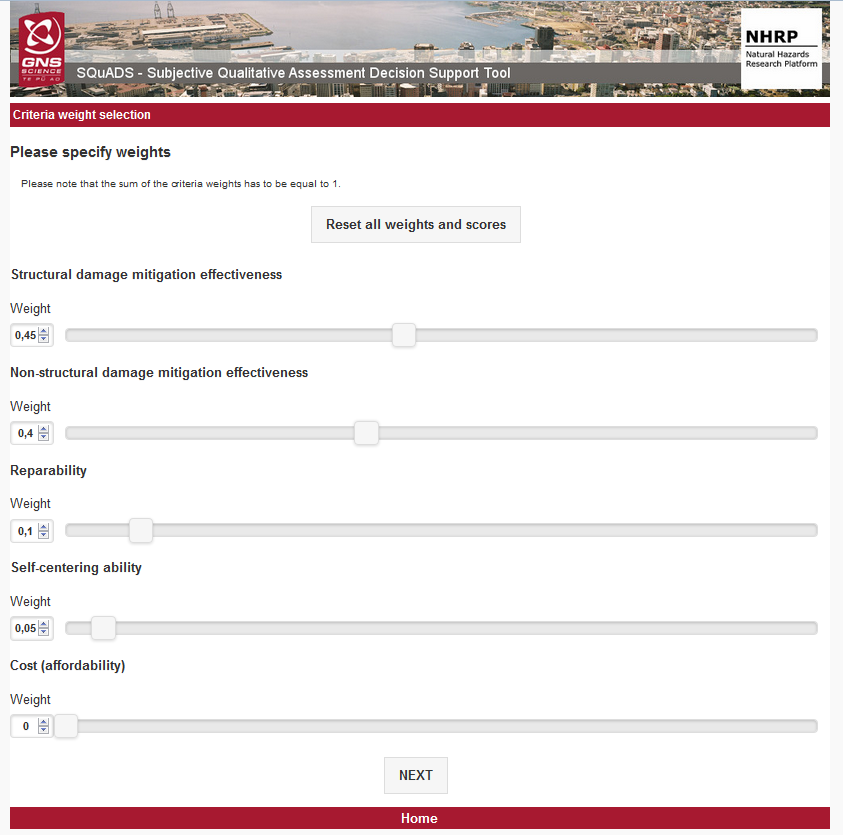
- First task is to assign 'weights' for main criteria that are of interest to the client. High importance criteria take on high weight values. Care is taken that the total sum of the weights assigned to main criteria is equal to 1.0. It is only then that the 'Next' button becomes active.
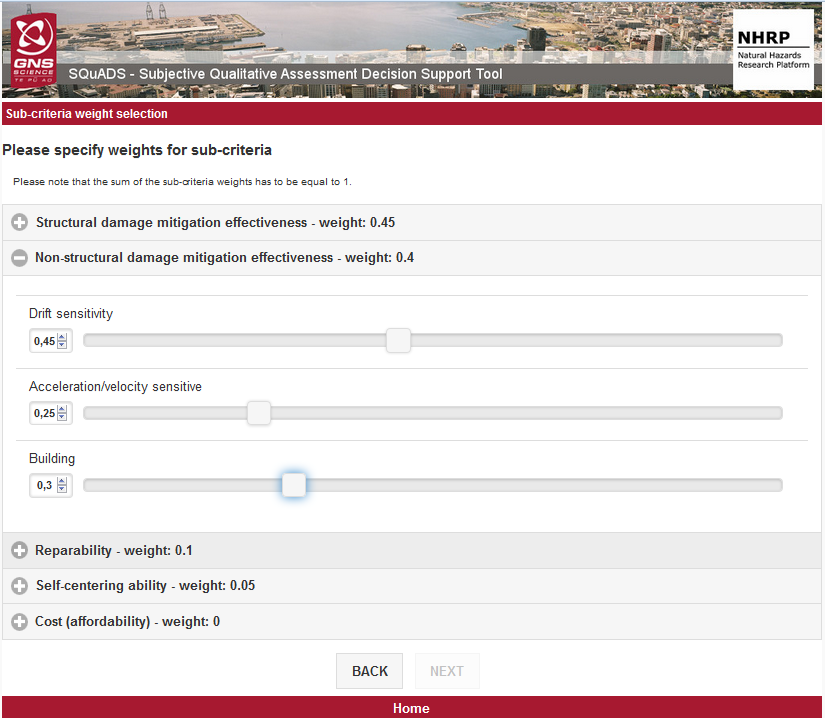
- Next task is to assign 'weights' for sub-criteria under each main criterion; these sub-criteria represent the factors that contribute to the main criteria. The sub-criteria assume weights according to their importance towards contributing to each main criterion. Again, high importance factors take high values for weights. Note that the total sum of weight for each set of sub-criteria must also equal to 1.0.
Scoring for structural system options and comparison displayed
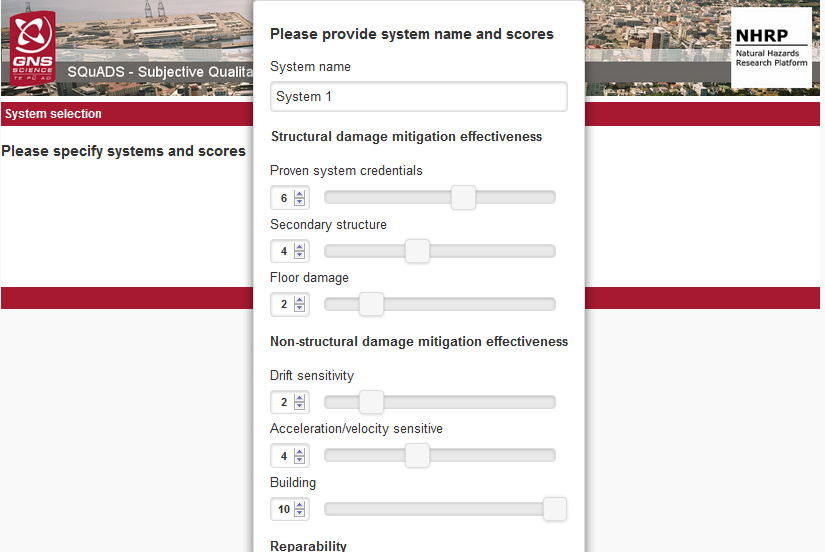
- Select a structural system
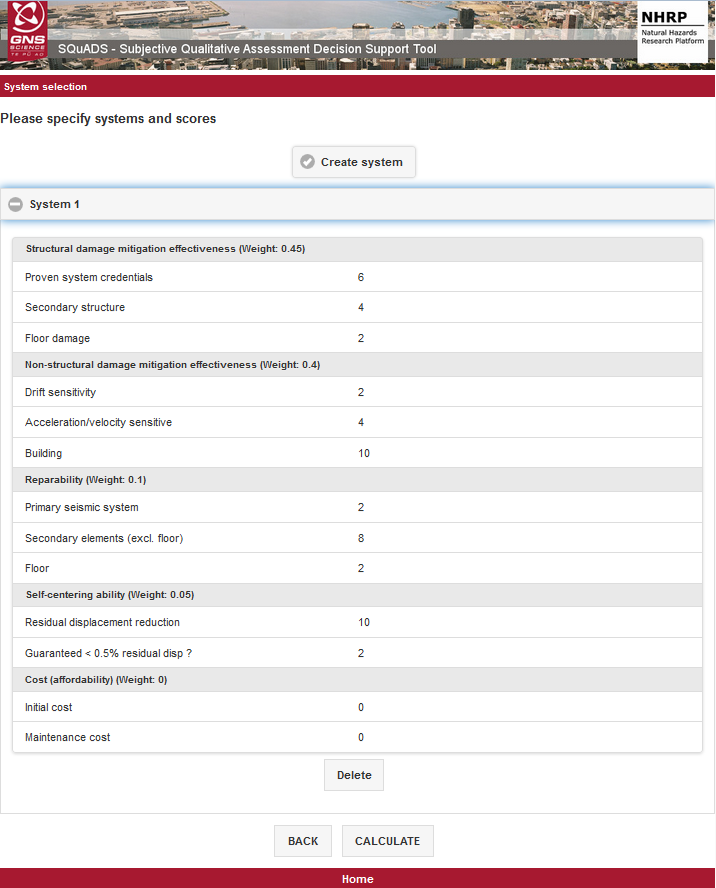
- Score the structural system against each sub-criterion independent of its importance/weight factors assigned; the best performance is represented with a high score and the score is reduced as the relative performance becomes poor.
- Press 'Calculate'. This step computes the total weighted score for the structural system chosen.
- Select the next structural system and repeat the above steps for scoring and calculating the total score.
- A list of structures chosen for the comparison purposes is displayed with their total score and they are sorted from the 'best' to 'poorest'.
Export PDF
The comparison exercise with input values and the computed weighted score can be exported as a PDF by the user for future reference.
References
-
MacRae, G.A., Golondrino, J.C., Yeow, T. 2014. Which structural system is best? ASEC conference proceedings, paper 177, Auckland.
-
Royal Commission on Canterbury Earthquakes. 2012. Royal Commission Report Part 1, Volume 3: Low Damage Building Technologies. ISBN: 978-0-478-39558-7.
-
Hare, J., Oliver, S. Galloway, B. 2012. Performance objectives for low damage design of buildings. NZSEE 2012 conference proceedings. Paper no: 35
You have accepted the Confidentiality Undertaking. Please click here to download.